
The steps at a glance
Opening a padel club means bringing together a business decision, a technical project and day-to-day management that lasts for years. There are nine steps, best taken in this order:
- check local demand and choose the location;
- define the space and layout;
- decide how many courts, and the mix of doubles and singles;
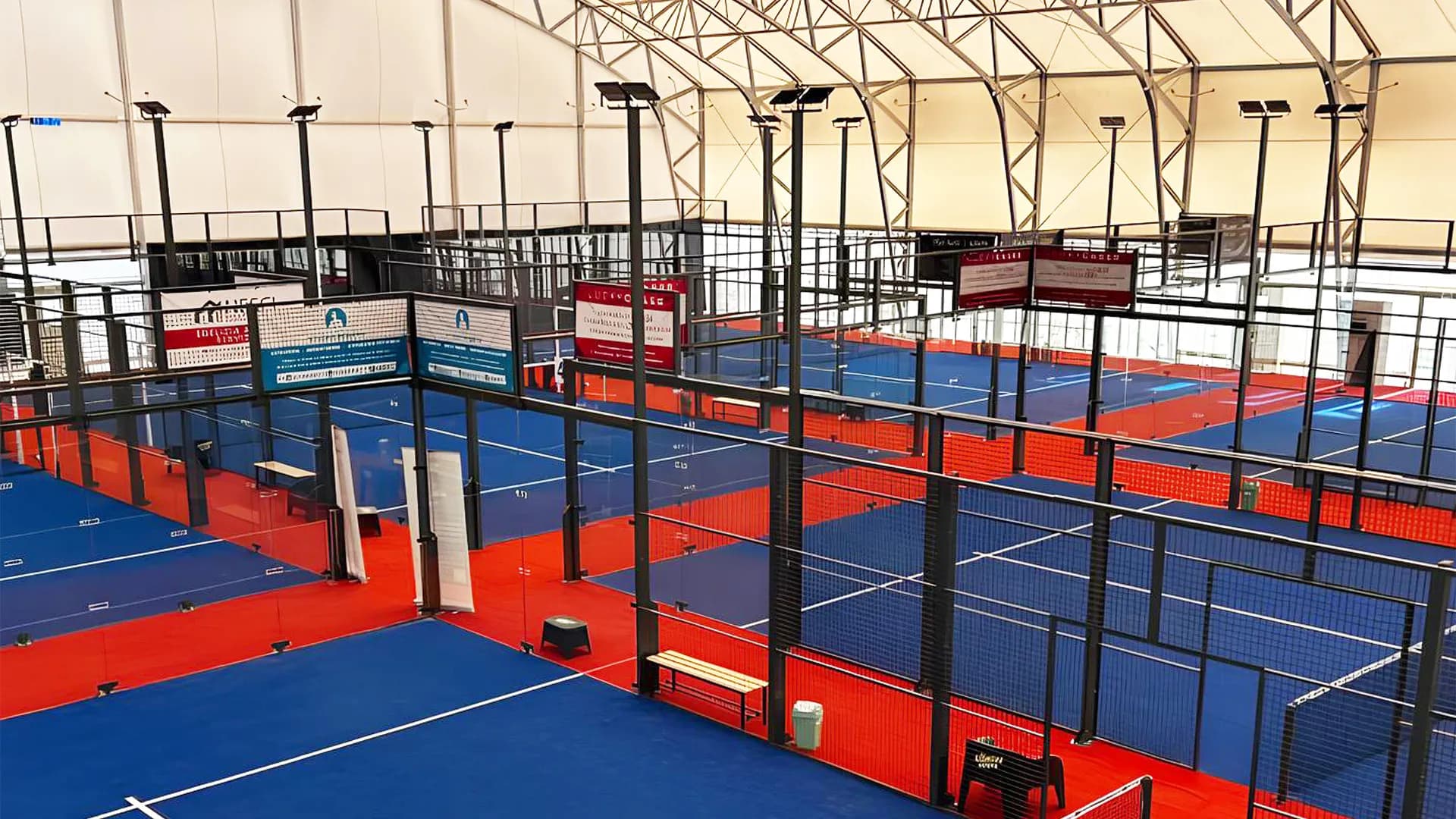
- choose between indoor, outdoor or covered outdoor;
- check the permits;
- choose the manufacturer;
- plan the timeline;
- define the complementary services;
- organise management and maintenance.
Each step is described below. At the end you will find a method to estimate the return of a court.
1. Local demand and location
The market comes before the courts. Find out how many players there are in the area, how many clubs already exist and how easy it is to find a free court at peak times. Waiting lists and courts that are always full in the evening are a sign of unmet demand.
Location matters as much as demand: accessibility, parking, visibility and proximity to residential or business areas all affect everyday bookings.
2. Space and layout
A doubles court measures 20×10 m, a singles court 20×6 m. The International Padel Federation Rules of Padel set the court at 10 by 20 metres, measured inside, and require a minimum free height of 6 metres, suggesting 8 for new facilities. You also need adequate clearances around the structure: the figures are in our guide on how much space a padel court needs.
Layout is not only about the courts. Plan for access routes, changing rooms, a reception, waiting areas and space for spectators, and leave room for future courts.
3. Number of courts and the doubles/singles mix
The number of courts depends on estimated demand and the space available. A few qualitative points help:
- more courts let you host tournaments and leagues, offer more slots at the same time and absorb evening peaks;
- doubles courts are the standard format for regular play, because padel is played in pairs, and in the regulation version they allow official competitions;
- singles courts suit one-on-one play, training and lessons, and take up less space;
- starting with fewer courts and leaving room to grow reduces risk while demand is still being tested.
4. Indoor, outdoor or covered
Choosing between an indoor court, an outdoor court or a covered outdoor court decides how many months a year the club can operate. It depends on the local climate, the space and whether a building is available. The full comparison is in our guide on indoor or outdoor padel courts.
5. Permits
Permits depend on the context, the type of work and local regulations. Check them with a qualified professional and the local authorities before fixing the project timeline, because they can affect the schedule more than the court assembly does.
6. Choosing the manufacturer
The manufacturer determines the quality of the materials, delivery times and support in the years that follow. Compare several suppliers on the same criteria and get everything in writing: the criteria and the questions to ask are in our guide on how to choose a padel court manufacturer.
7. Timeline
The project schedule is planned back from the opening date. The longest phases are usually permits and on-site works; supplying the courts is the most predictable part. With our turnkey service there are 17 days from order signature to installation. What affects the overall timeline is explained in our guide on installation time.
8. Complementary services
A padel club does not live on courts alone. The options to consider from the start are:
- lighting, to use the evening hours: on our courts, LED fixtures on dedicated poles are included in the supply;
- covers, to operate all year round;
- outdoor flooring or resin, glass graphics, post protections and heating;
- a beach volleyball court, which broadens the offering and makes use of outdoor space: the key features are in our guide on beach volleyball courts for sports centres.
9. Management and maintenance
Daily maintenance preserves playing conditions and the life of the turf. The basic rule concerns the silica sand, which should be redistributed every day and topped up every week. Other tasks are covered in our guide on padel court maintenance, and the signs that the turf needs replacing are in our guide on when to replace the turf.
Your management plan should also cover staff for court care and the supplier's after-sales support, for replacing glass and turf when needed.
How to estimate the return of a court
How much a padel court earns depends on variables that change from one market to another. That is why there is no figure that holds everywhere: there is a method, to apply with the values of your own area.
| Variable | What it represents | How to estimate it |
|---|---|---|
| Bookable hours | The hours the court can be rented in a year | Opening hours times days of operation, minus closures |
| Occupancy rate | The share of bookable hours actually sold | By observing local clubs and demand across time slots |
| Hourly rate | The average price of one hour of court time | By comparing local rates, by time slot |
| Operating costs | Staff, energy, maintenance, insurance, overheads | From quotes and the actual costs of similar facilities |
| Depreciation | The yearly share of the initial investment | By dividing the investment by its expected useful life in years |
The potential revenue of a court is calculated as follows:
potential revenue = bookable hours × occupancy rate × hourly rate
Operating costs and depreciation are then subtracted from potential revenue to reach the margin. All values must be estimated on your own market: borrowing figures from another city or another club leads to the wrong conclusions. It is worth running the calculation in at least two scenarios, a cautious one and an expected one.
The same method also shows what opening sooner is worth: the tool on our turnkey page calculates, with the figures you enter, the value of the days of activity you gain.
If you are planning a padel club, let's talk: we can help you define the courts, the space and the project timeline.